
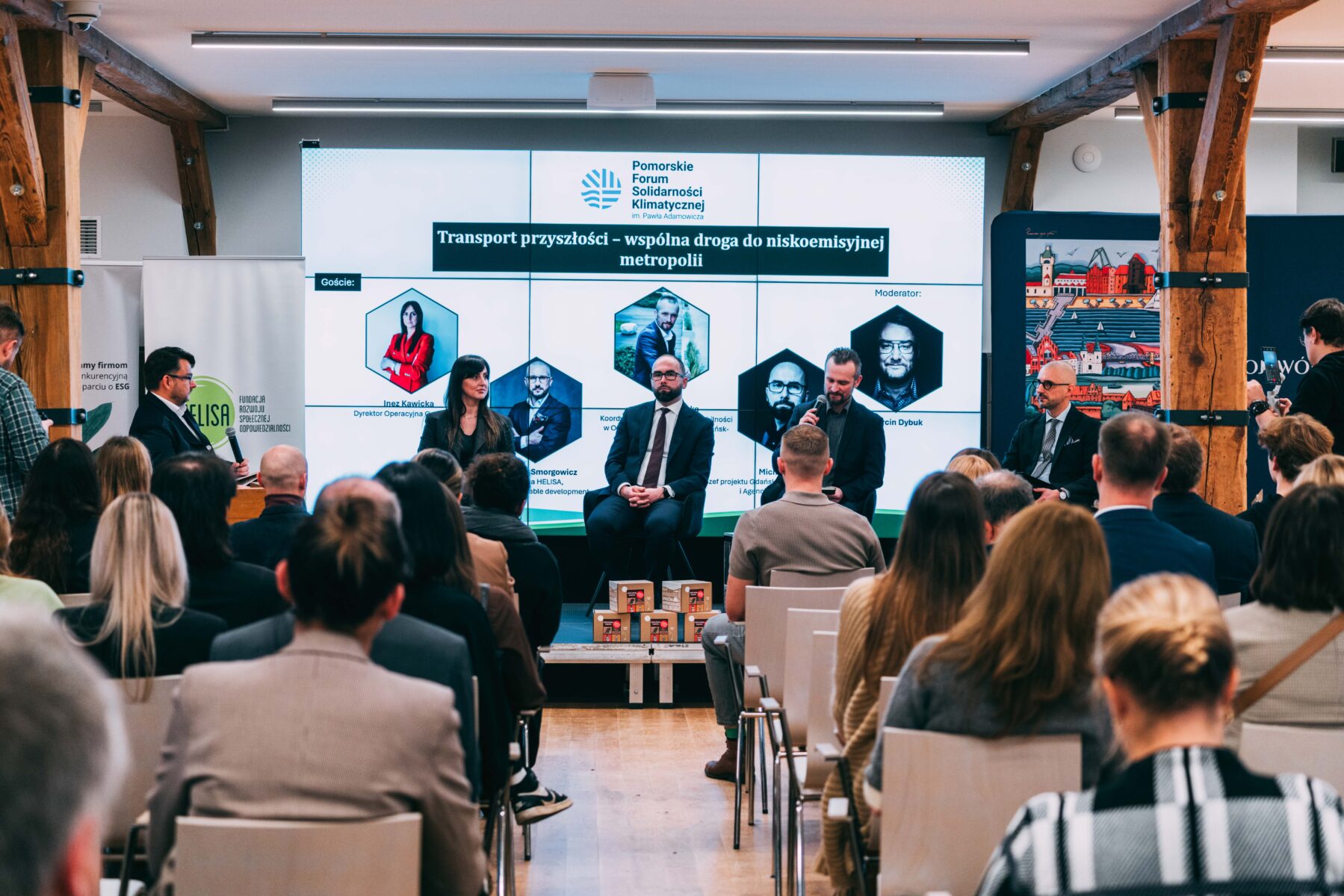
On December 4, 2025, another edition of the Paweł Adamowicz Pomeranian Climate Solidarity Forum – an event that brings together experts, local government, business, and urban communities around the most important challenges of climate transformation. One of the key panels was the meeting „Transport of the Future – A Common Path to a Low-Emission Metropolis”, which was attended by Michał Jamroż, project manager of Gdańsk Nowe Południe.
In the panel, along with representatives from OMGGS, HELISA, and Omida Group, they discussed how a metropolis can reduce CO₂ emissions, develop intelligent mobility, and design urban space in a way that genuinely impacts the quality of life.
Urbanism Instead of Combustion
In his TEDx talk, Michał Jamroż shifted the focus from technology to people and their daily lives. Instead of discussing which engine burns less, he invited the audience to look at a completely different level – at the city map and how its shape determines our choices. He emphasized that public transport is ecological by definition, but it has no chance of working effectively if the city forces residents to travel long distances daily. „The most ecological kilometer is the one we don't have to travel,” he said, showing that the issue of mobility begins much earlier than at the platform or bus stop. He pointed out that pedestrians and cyclists should form the core of urban mobility, and public transport should be their stable support, not competition. The problem is not whether we travel by electric, hydrogen, or combustion vehicle – the real trouble arises where the city is too sprawling, services are too far away, and one cannot get to school or the shop without a car. This is precisely why sustainable mobility begins with smart urbanism, not technology. Michał cited examples from Copenhagen, Vienna, and Freiburg – cities that have shown that consistent space design can genuinely change residents„ daily habits. Not because they were ”convinced" of ecology, but because the city was designed so that the sustainable choice became the obvious choice.
What does this mean for the Gdańsk Nowe Południe project?
The Gdańsk Nowe Południe project is already implementing these assumptions through:
• Transit Oriented Development (TOD) – intensive, mixed-use development in the vicinity of future PKM Południe stops;
• local district centers – places where one can live, work, shop, and relax without the need for daily long commutes;
• priority for pedestrian and cycling traffic, with public transport as the foundation of the system;
• reducing distances to services, schools, and workplaces, which directly translates into reduced CO₂ emissions;
• coordination of road and rail transport as a single metropolitan network.
Gdańsk Nowe Południe: A Project That Responds to Real Challenges
What resonated particularly strongly during the discussion was the fact that low-emission transport is not a technological project, but an urbanistic one. And a well-designed district – dense, accessible, vibrant, co-created with residents – is one of the most effective climate tools that cities have.
The Gdańsk Nowe Południe project is being created in this spirit: to reduce distances, improve access to services, and create a district that operates in the rhythm of residents' daily lives – not the other way around.


